Why is it important to follow the recipe when treating seeds?

In seed treatment, the technical recommendation is constructed from tests and validations. Following it rigorously helps maintain tank mix stability, coating uniformity, and process consistency throughout the operation.
In everyday life, many people have realized that some tasks require attention to detail. A simple example is a cooking recipe. When the ingredients, quantities and order of preparation are respected, the result is usually exactly as expected.
Now imagine preparing a cake by altering quantities or skipping steps. It's possible it might even turn out, but it will hardly have the same texture or consistency as predicted in the original recipe.
In seed treatment, something very similar happens.
The technical recommendation used in the operation functions like a carefully developed recipe by agronomists, researchers, and specialists. Therefore, each component, each dose, and each step of the process has a technical reason.
And it is precisely for this reason that following this guideline precisely contributes to maintaining the quality of treatment throughout the entire operation.
The importance of technical recommendation in seed treatment
In modern agribusiness, the seed represents one of the main points of convergence between genetics, technology, and productivity. However, for all this potential to be preserved, treatment needs to be carried out with precision.
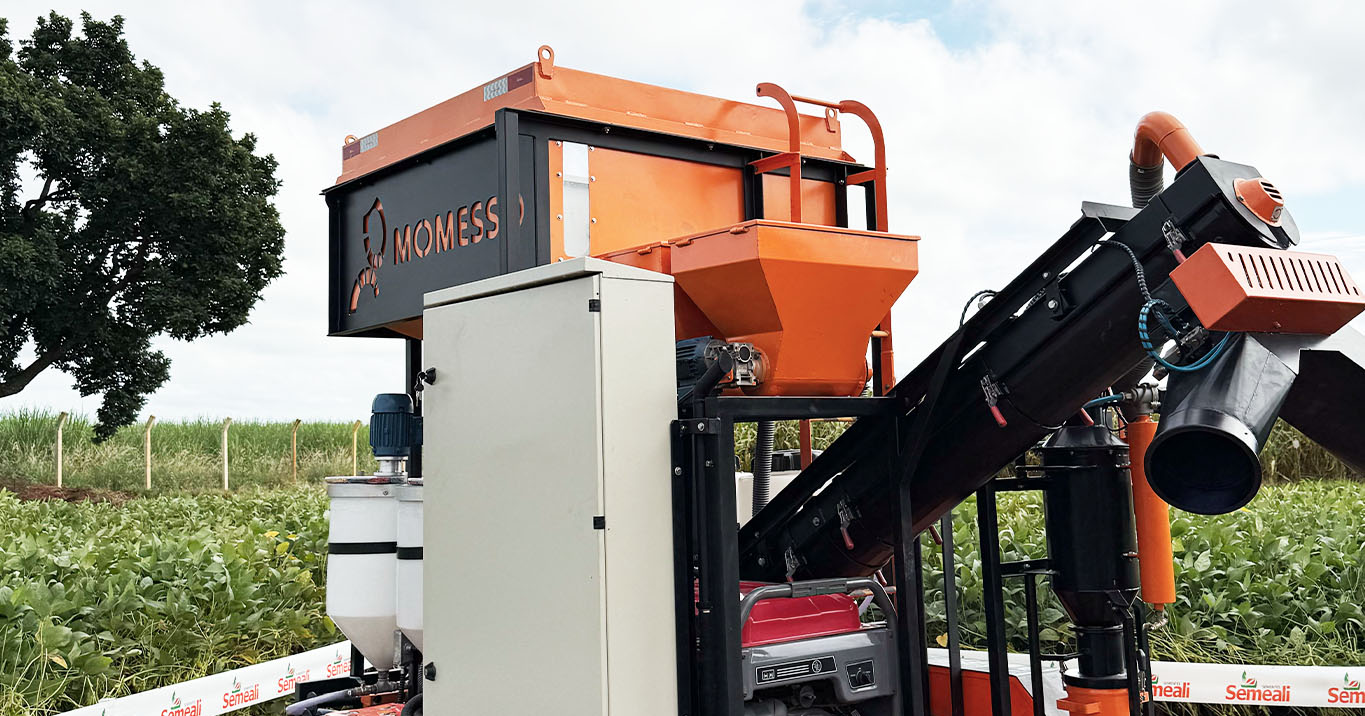
O Industrial Seed Treatment TSI has exactly this objective: to apply products in a controlled, uniform, and repeatable manner, respecting established technical recommendations.
These recommendations are not random. On the contrary, they are the result of laboratory studies and field tests that determine:
- suitable combination of products
- correct mixing order
- application volume
- Boiler behavior throughout the process
Therefore, following this guidance helps maintain application stability and uniform seed coating.
The treatment syrup and the importance of stability
One of the central elements of seed treatment is the application slurry.
It is formed by mixing liquid and solid products that will be applied to the seed surface. However, for the application to occur homogeneously, this mixture needs to remain stable throughout the entire process.
When stability is maintained, the components remain well-distributed within the solution. This way, each seed receives the same coverage pattern.
On the other hand, the stability of the syrup depends on some important technical precautions, such as:
- correct order of adding products
- Proper mixture of components
- continuous agitation during operation
For example, when these factors are not observed, separation of elements from the mixture can occur. In some cases, denser products may concentrate at the bottom of the reservoir. In others, small particles may cluster together, altering the behavior of the slurry.
Consequently, the distribution of the treatment on the seeds may present variations.
And here there's an important question for those who work in this operation:
In your treatment unit, does the applied syrup maintain the same characteristics defined in the technical recommendation? This reflection helps to understand the level of control in the process.
Dosage: the central point of the technical recipe
Another decisive factor in seed treatment is dosage accuracy.
Each product used has specific application recommendations. Therefore, respecting these quantities helps maintain the balance between seed protection and process efficiency.
When the dosage strictly follows the technical recommendation, the application occurs within the expected standard. Furthermore, accuracy in dosage also helps maintain the rational use of inputs used in the operation.
In this scenario, technology plays an important role.
Modern seed treatment equipment features automated systems capable of controlling product application with great precision. Dosing pumps and flow sensors, for example, allow real-time monitoring of the volume applied.
Consequently, the application ceases to depend exclusively on manual adjustments and becomes driven by defined and monitored parameters.
Repeatability: maintain the standard throughout the operation
Following the technical recipe doesn't just mean getting a single batch of treatment right. The real challenge lies in maintaining the same standard throughout the entire operation. After all, in industrial treatment units, thousands of seeds go through the process daily.
Therefore, in addition to accuracy in dosing and spray stability, another essential factor comes into play: process repeatability. Repeatability means that the same recipe can be applied multiple times while maintaining the same quality standard. Thus, batch after batch receives the same technical treatment.
At this point, automation systems contribute significantly.
Equipment equipped with HMI (Human-Machine Interface) interfaces allows for the registration and storage of treatment recipes. This way, the operator can select predefined parameters for each type of seed and product combination.
With this, the machine executes the process following exactly the same operational adjustments.
Technology and engineering in the service of precision
The evolution of seed treatment follows the advancement of engineering applied to agribusiness.
Today, machines developed specifically for TSI are designed to control important process variables, such as:
- application rate of products
- seed flow within the equipment
- residence time in the mixing system
- coverage pattern
When these factors are monitored, the operation gains stability and predictability. It is within this logic that the solutions developed by Momesso were conceived.
The company works in the development of equipment that integrates automation, operational control, and precision engineering. In this way, the treatment process begins to follow well-defined technical parameters, contributing to maintaining the application standard throughout the work routine.
Additionally, initiatives like the Momesso Experience Center (CEM) allow for the validation of technologies and processes, connecting technical knowledge with the practical realities of field operations.
In many agricultural operations, efficiency is born from seemingly simple decisions. Following a technical recommendation might seem like just a detail. However, when this care is maintained throughout the entire process, the result appears in the consistency of the operation.
A well-structured process strengthens operations.
In seed treatment, each step plays an important role. From the preparation of the slurry to the control of dosage and application, all details contribute to the final quality of the process.
Therefore, following the technical recommendation is not just operational guidance. It's a path to transform scientific knowledge into field practice.
When well-structured processes, adequate technology, and applied engineering work together, seed treatment gains consistency and predictability.
And it is precisely in this scenario that solutions developed with a focus on precision, like those from Momesso, help support agricultural professionals in conducting increasingly efficient operations.
After all, in agribusiness, well-defined processes contribute to transforming knowledge into results in the field.
READ ALSO:

Como a automação organiza operações de tratamento de alto volume