When technical decision replaces “guesswork” in seed treatment

In the field, experience counts a lot. However, when it is combined with data, processes, and technology, decisions gain even more precision. Have you ever stopped to consider how much a decision based solely on perception can impact crop yield?
In agribusiness, making decisions is part of everyday life. Every day, producers, agronomists, and seed company managers evaluate scenarios, choose strategies, and conduct operations that directly influence crop yield. However, in an environment where investments are high and margins are increasingly tight, each decision needs to be more and more well-founded.
It is at this point that an important reflection arises: to what extent are operational decisions based on data and well-defined processes?
Field experience is a valuable asset. However, when combined with technical knowledge, engineering, and applied technology, the potential for efficiency consistently increases. This way, decision-making is no longer solely dependent on perception and becomes supported by concrete information.
And that's precisely where an important shift begins in how operations related to seeds are conducted.
The importance of technical decisions even before planting
When we talk about productivity, it's common to immediately think about planting, climate, or crop management. However, a large part of the result starts much before that.
Seed preparation, especially during the processing and treatment stages, directly influences crop uniformity. After all, it is at this point that the productive potential begins to be organized and protected.
For example, imagine two distinct scenarios.
In the first, the seed preparation process occurs with strict quality control, batch standardization, and technically precise treatment.
In the second case, decisions are made solely based on visual perceptions or poorly controlled operational adjustments.
In practice, the difference between these two scenarios can appear in details that make a big difference in the field: uniformity, early vigor, and adequate seed protection.
Therefore, understanding the importance of these steps is fundamental for those seeking operational efficiency and consistent results.
When small variations create big impacts
Have you ever stopped to think about how small variations in the process can impact the crop?
In many operations, minimal differences in product dosage, treatment distribution, or seed standardization can lead to different results among plants in the same plot.
Consequently, the crop begins to show distinct levels of development. Some plants emerge more quickly, others face more difficulty, while some do not express their full genetic potential.
This type of variability is not always immediately perceived. However, throughout the crop cycle, it can influence aspects such as:
- stand uniformity
- early plant development
- utilization of the productive potential of the hybrid or cultivar
- efficiency of the following operations in the field
Therefore, more and more agricultural professionals are directing their attention to what happens before the seed reaches the soil.
The seed as a central point of efficiency
Those who work with seeds know that quality doesn't happen by chance. On the contrary, it is the result of a technical process that involves knowledge, engineering, and operational control.
In this context, seed beneficiation plays an essential role.
Through classification and separation technologies, such as the density table, it is possible to organize seed lots more homogeneously. Thus, seeds with greater vigor and productive potential proceed to the next stages of the process.
Furthermore, batch standardization contributes to more consistent treatment application. This way, each seed receives the same attention and level of protection.
In other words, beneficiation creates the necessary conditions for seed treatment to occur efficiently.
Industrial seed treatmentprecision that makes a difference
After processing, a step that has been gaining increasing importance in modern operations comes into play: Industrial Seed Treatment (TSI).
In this process, precision becomes a determining factor.
Ultimately, the treatment needs to adhere to three fundamental principles:
- Accuracy
Each product used has specific technical recommendations. Therefore, the application must strictly follow these guidelines to ensure adequate protection and performance.
- Uniformity
The product needs to be distributed homogeneously on each seed. This way, all receive the same level of coverage.
- Repeatability
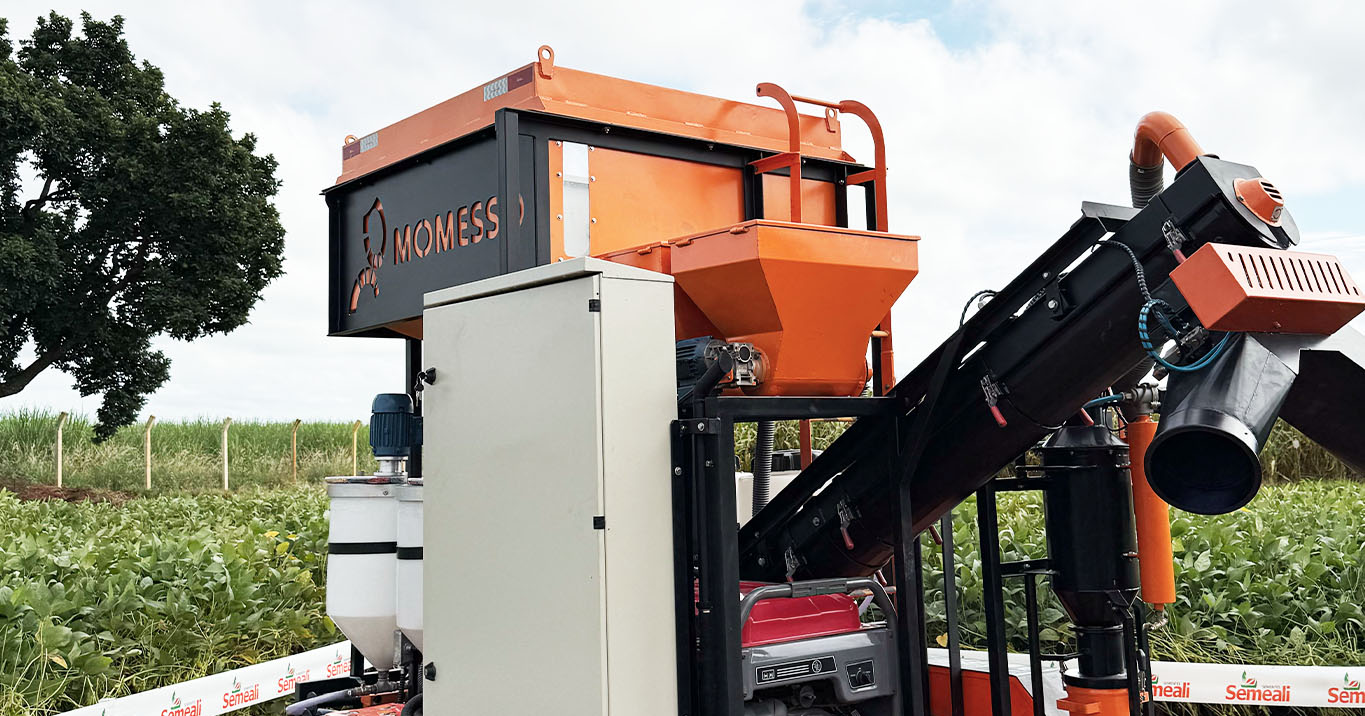
The quality standard must be maintained in all batches processed throughout the operation. Momesso machine Deliver this!
This is precisely where technology and engineering make a difference. Equipment designed for industrial treatment allow the process to be conducted with control and stability, reducing variations and bringing greater predictability to the operation.
An important question for those who work with seeds. Now it's time for practical reflection.
In your operations, is there clear data on the quality of the treatment performed on each batch of seeds?
This question helps to understand the level of control that exists within the treatment or processing unit.
When processes are monitored and recorded, decisions are made based on concrete information. This way, operators, managers, and agronomists can track important operational indicators.
Additionally, traceability allows for the identification of improvement opportunities and process adjustments whenever necessary.
Technology as an ally in farm management
Modern agriculture has shown that technology is not only in the field or in seed genetics. It is also present in the management of production processes.
Automated systems with HMIs (Human-Machine Interfaces), for example, allow for real-time monitoring of operational parameters. Thus, the operator can monitor dosages, volumes, and machine performance throughout the entire process.
Furthermore, this information can be recorded and used for later analysis. Consequently, the operation becomes more transparent and data-driven.
This type of approach transforms the work routine into a flow of applied knowledge. In other words, each operation starts generating information that helps improve future decisions. And guess what? Momesso machines deliver this!
Engineering applied to seed treatment
It is within this logic that the solutions developed by Momesso come in.
Over decades of operation in agribusiness, the company has directed efforts towards developing machines and systems that bring precision, standardization, and operational control to the treatment e processing from seeds.
In addition, the work carried out in Momesso Experience Center (CEM) contributes to validating technologies, testing processes, and bridging engineering and field practice.
This way, technical knowledge is not restricted to the research environment. On the contrary, it reaches the operational level, supporting producers, seed companies, and agricultural professionals in the pursuit of increasingly efficient processes.
Knowledge: one of the most valuable inputs for the harvest
When observing the entire production chain, it becomes clear that the seed carries much more than genetic material. It carries the productive potential of the entire crop.
Therefore, treating this resource with technical rigor is a strategic decision.
Well-structured processing and treatment methods contribute to organizing this potential from the outset. Consequently, the crop develops with greater uniformity and predictability.
In other words, the success of the harvest begins long before planting. It begins with the choices made during seed preparation.
And it is precisely at this moment that technology, engineering, and knowledge become important allies.
Well-founded decisions strengthen the operation
In agribusiness, experience and knowledge go hand in hand. Hands-on experience in the field remains essential. However, when it is connected with data, technology, and well-defined processes, decisions become even more consistent.
Therefore, investing in structured seed beneficiation and treatment processes means strengthening the foundation of agricultural production.
After all, each seed represents an opportunity for productivity in the field.
And when reliable technology, applied engineering, and technical knowledge work together, productive potential finds ideal conditions to develop from the very first moment of the harvest.
If you work with seeds and are looking to better understand how technology and engineering can contribute to the efficiency of your operation, getting to know the solutions from Momesso could be a good next step on this journey.
READ ALSO:
Como a automação organiza operações de tratamento de alto volume