Every drop counts for your profitability and the future of agriculture.

In the daily life of the field, we are always looking at the details that impact the final outcome of the harvest. From soil preparation to harvest, every decision counts. But have you ever stopped to think about the financial and environmental weight of a single drop of product in seed treatment? It may seem like little, but when we multiply that drop by millions of seeds, the result can be the difference between profit and loss.
Many seed producers and managers face a common dilemma: how to consistently apply the recommended dose of pesticides and polymers without wasting expensive inputs or compromising crop and environmental safety? Seed treatments that result in “sticky” seeds with excess product, or worse, seeds with coverage gaps, are a warning sign. This isn't just an operational problem; it's a direct drain on your profitability.
The invisible cost of inaccurate treatment
Let's talk numbers. Seed treatment, whether industrial (TSI) or on-farm, is one of the highest return investments in agriculture. According to Embrapa data, the cost of treatment represents, on average, only 2.2% of the total soybean production cost, but its impact on the protection of the initial stand is immense. However, this low percentage can be misleading if the application is not efficient.
The problem is that inaccuracy costs money in two ways:
Overdosing: Applying more product than necessary is the same as throwing money away. Inputs like fungicides, insecticides, and high-performance polymers are expensive. An overdose of 10%to 15%, which is common in non-automated or poorly calibrated systems, can mean thousands of reais wasted by the end of a workday. In addition to the financial cost, excess product can cause phytotoxicity, harming germination and seedling vigor.
Underdosing: This is the silent risk. Applying less product than recommended creates a false sense of security. The seed goes to the field without adequate protection, becoming vulnerable to attack from soil pests and diseases. The result? Stand failures, plant loss, and compromised final productivity, which negates all investment made in genetics and inputs.
In both cases, the loss is certain. Imprecision turns a strategic investment into an unnecessary cost and a risk to the crop.
Does this happen in your operation?
Consider your treatment process for a moment. Is equipment calibration performed with each batch or product change? Can you ensure that the first and last seed of a batch receive exactly the same dose of liquid? Is product mixing done manually, making it prone to measurement errors?
If any of these questions raised a doubt, it might be time to take a closer look at the technology behind your treatment. The pursuit of a perfect stand and maximum productivity no longer leaves room for guesswork in dosage. Precision has ceased to be a differentiator and has become a fundamental requirement for competitiveness and sustainability. Beyond the financial impact, discarding leftover spray mixture or excessive use of pesticides represents an environmental risk that modern agriculture can no longer ignore.
Engineering and automation in service of perfect dosing
The answer to the precision dilemma lies in the technology embedded in treatment equipment. The era of manual calibration and approximate mixing is giving way to intelligent systems, which bring engineering accuracy into the seed treatment process.
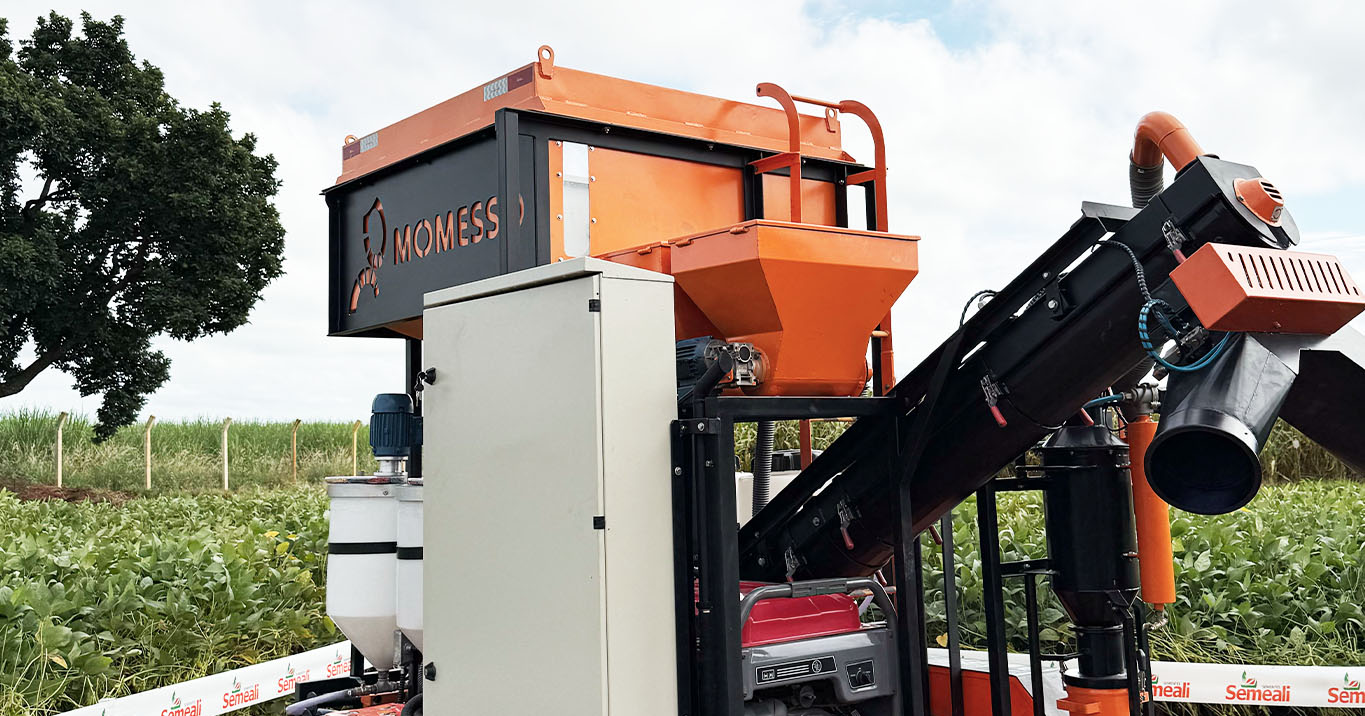
High-performance equipment, like the solutions developed by Momesso, are designed with a clear objective: to ensure that each seed receives the exact dose of product, always. This is possible thanks to a combination of factors:
Automated Dosing Systems: The heart of precision. Peristaltic or flow pumps, controlled by a computerized system, inject the exact amount of each product directly into the treatment chamber. The operator simply enters the recipe (dose in ml/100kg) and the system takes control, eliminating human error and ensuring repeatability.
Sequential and Contamination-Free Application: Instead of mixing all products in a single tank, risking compatibility and spray stability, modern technology allows for sequential application. The machine can apply the fungicide, then the insecticide, and finally the polymer, all in the same process but with individualized channels. This ensures the maximum effectiveness of each component.
Continuous Flow Control: The machine “knows” how many seeds are passing through it in real-time. Flow sensors automatically adjust the slurry injection. If the seed flow decreases, the dosage also decreases. If it stops, application ceases instantly. The result is zero waste and uniform coverage from the beginning to the end of the batch.
This automation not only optimizes the use of inputs but also generates valuable data. Managers will know exactly how much product was used, the treatment yield, and will have precise reports for more efficient management.
Accuracy isn't a cost, it's a smart investment.
Let's get back to our droplet. In a precise treatment system, every drop of product is converted into protection and productive potential. The investment in pesticides, polymers, and nutrients is fully utilized, and the return on it is maximized. Profitability increases not only through savings on inputs but mainly through the security of a well-established crop.
At the same time, environmental responsibility is put into practice. Exact dosing means less waste, less disposal, and more rational use of resources, aligning operations with the best sustainability practices that the market and society demand.
Therefore, when evaluating your seed treatment technology, don't just think about tons per hour of processing capacity. Think about system intelligence in milliliters per seed. Choosing reliable technology that incorporates decades of engineering experience and a deep understanding of the field is what ensures every drop invested today turns into the best yield tomorrow.
READ ALSO:
Como a automação organiza operações de tratamento de alto volume