
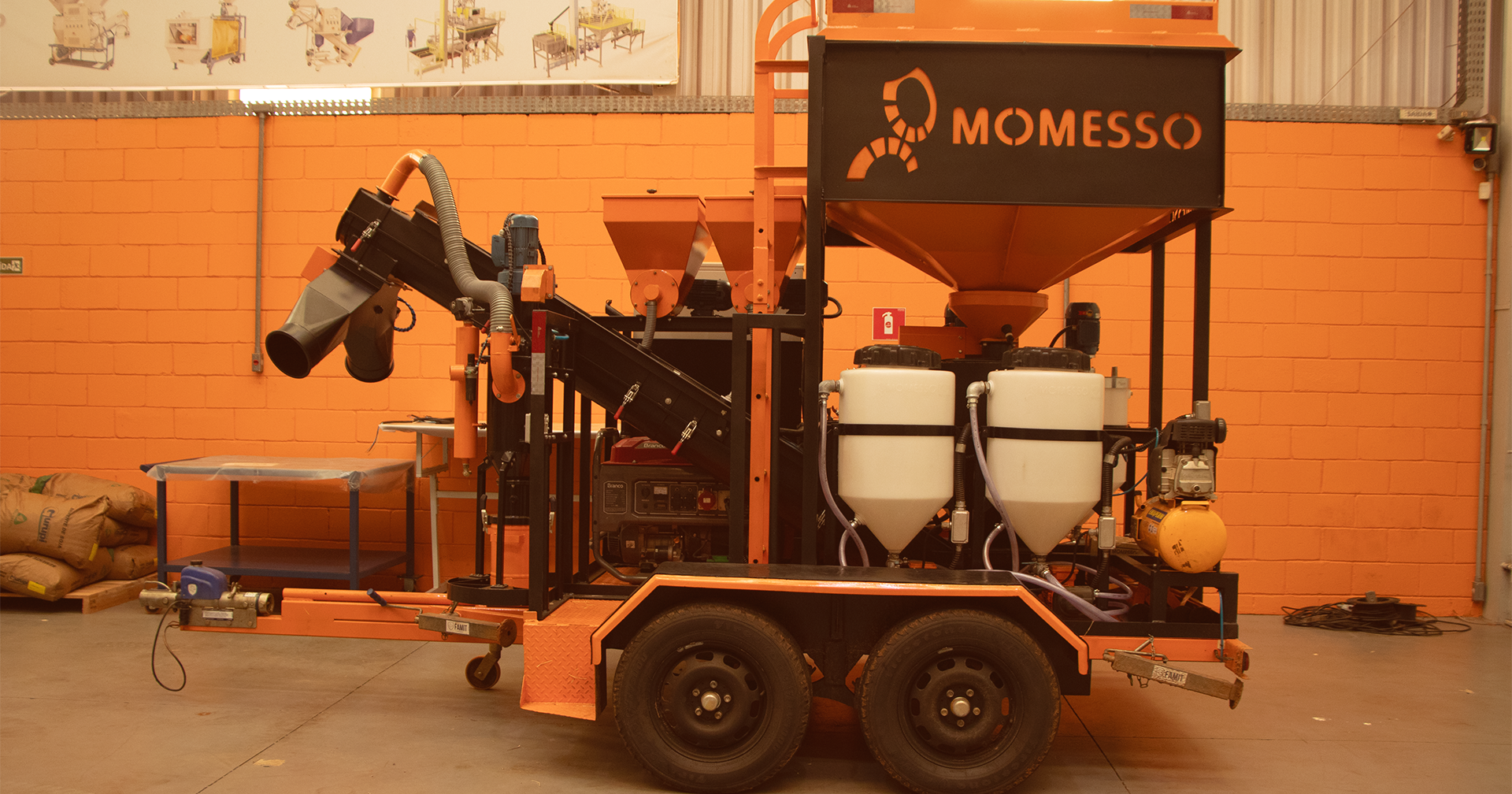
What happens inside the machine: atomization, homogenization, and uniform distribution
Understand how atomization, homogenization and uniform distribution influence seed treatment stability and batch-to-batch consistency.
Treatment starts inside the machine
For those who observe the seed treatment From the outside, the process may seem simple: apply a product and move on to the next stage. However, inside the machine there is a sequence of technical interactions that determine the final quality of the treatment.
Atomization, homogenization and uniform distribution are not isolated concepts. They form an integrated system that directly influences the stability of the process, the behavior of the batch and the repeatability of the operation.
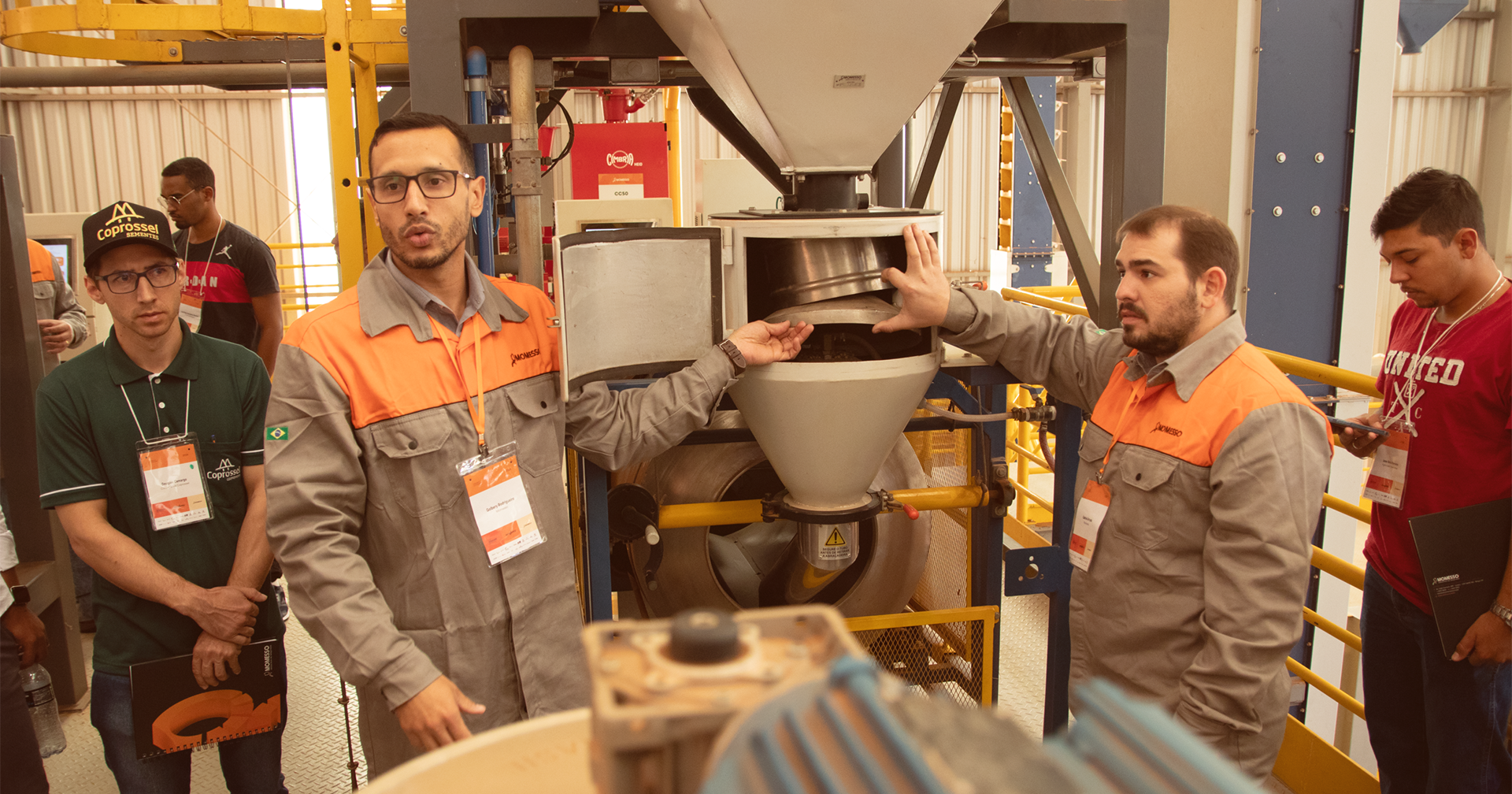
In the view of Momesso, Understanding what happens inside the machine is essential if seed treatment is to evolve from an operational task into a well-run technical process.
Atomization: the starting point for stable application
Atomization is the stage responsible for transforming the treatment mixture into smaller particles, making it easier to disperse along the seed flow. The size of these particles directly influences application behavior. When atomization is inadequate, the mixture tends to form large droplets, which run off or concentrate at specific points. In other cases, excessively fine particles can get lost in the internal flow, reducing the efficiency of the application.
A well-adjusted atomization favors the stability of the dose applied, as it allows the product to be distributed in a more controlled manner throughout the process. This balance is essential for reducing local variations and strengthening treatment consistency.
In Momesso solutions, atomization is treated as an essential technical factor, integrated with the equipment's dosing and control systems.
Homogenization: where the application becomes a coating
After atomization, the challenge is to distribute these particles evenly among all the seeds in the batch. This is where homogenization plays a key role.
Homogenization promotes continuous contact between seeds and products by means of internal movements such as rotation, screws or bowls, depending on the model and capacity of the equipment. This movement reduces excess points and coverage gaps, creating a more coherent coating pattern.
The difference between applying the product and covering the seed correctly lies precisely at this stage. A poorly conducted mixture tends to generate seeds with different levels of coverage, increasing variability within the batch. For Momesso, homogenization is a critical point in the process, as this is where uniformity begins to form effectively.
Uniform distribution: the result of interaction between stages
Uniform distribution is the direct result of the interaction between atomization, homogenization and internal flow control. As the seeds move through the machine, the product needs to follow this movement coherently, maintaining rhythm and balance.
When these variables work in harmony, the coating tends to form a more even layer around the seed. This uniformity influences both the protection offered by the treatment and the behavior of the batch in the following stages.
Seeds with an even distribution of product have better fluidity, make sowing easier and reduce operational problems related to caking or batch segregation.
The role of internal flow in process consistency
The internal flow of the machine is one of the least visible but most decisive factors in the quality of the treatment. Speed, residence time and seed movement pattern directly influence the final result.
Unstable flows tend to generate variations in application and mixing. A well-controlled flow, on the other hand, favors repeatability and reduces the need for constant adjustments during operation.
Momesso engineering considers internal flow as a central part of machine design, seeking to create environments where the process remains predictable even in the face of natural batch variations.
Process engineering applied to seed treatment
For Momesso, The efficiency of the treatment is not just in the individual components, but in the way they work together. Atomization, homogenization and uniform distribution are thought of as parts of an integrated system.
This approach gives the operator greater control over the process and allows them to better interpret the batch's behavior throughout the operation. The result is a more stable treatment, with fewer interferences and greater consistency between treated batches.
Understanding what happens inside the machine is an important step towards improving the quality of treatment and strengthening operational consistency.
When the internal process supports repeatability
The repeatability of the treatment comes from the predictability of the internal process. When atomization, homogenization and uniform distribution are well adjusted, the treatment no longer depends on constant corrections and begins to follow a more solid technical standard.
This pattern facilitates the CTS, This reduces variables and contributes to a more reliable process throughout the harvest.
For those looking to raise the level of seed treatment, looking inside the machine means understanding that the final quality starts with the way each internal stage is carried out.
Do you want to deepen your understanding of the internal factors that influence the quality of seed treatment? Talk to us!
READ ALSO:

Are you afraid of becoming a more technological producer?
