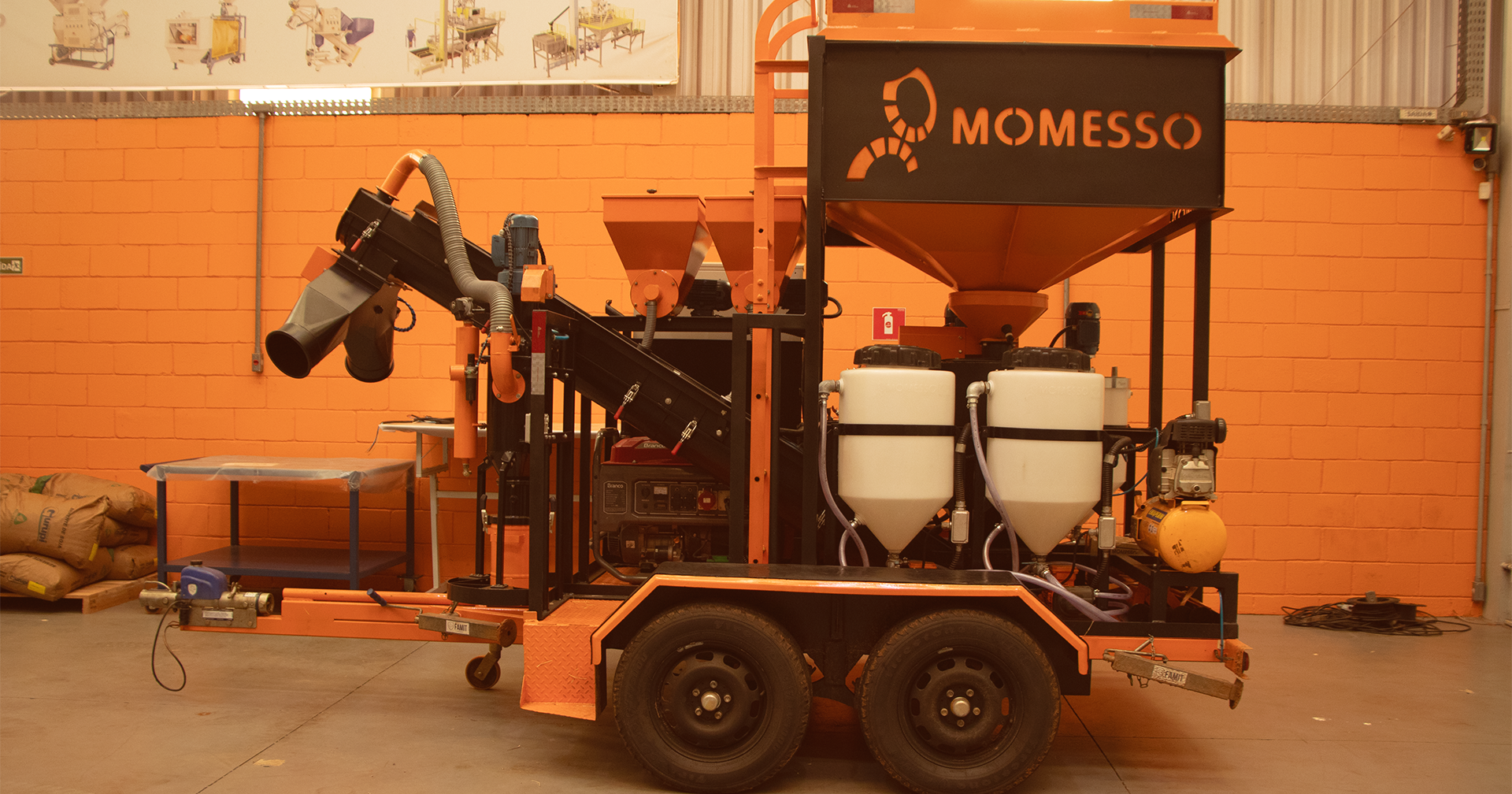
Is a brightly colored seed well-treated?

Precision, uniformity and control as the true pillars of industrial seed treatment.
Seed treatment (ST) is perhaps the stage with the greatest leverage in the entire agricultural production chain. This is when a relatively small investment in technology and inputs protects the genetic potential of a much greater value that will go on to the field. Even so, the market insists on a dangerous simplification: the idea that treating seeds is just “coloring” them.
This superficial reading creates a false sense of security. Visually well-finished plots give the impression of a job well done, when, in practice, the process may have failed at essential points. The result shows up later, in the field, in the form of poor stands, plants with uneven vigor and greater pressure from pests and diseases at the very beginning of the cycle. When this happens, there is no longer any room for correction.
The truth is simple and straightforward: seed treatment of high performance is not aesthetics, but the process. And the process, when conducted well, follows clear, measurable and repeatable technical criteria.
Real industrial processing is based on three non-negotiable and interdependent pillars: precision, uniformity and control. The absence of any one of them doesn't just weaken the result. It compromises the purpose of the treatment as a whole.
Why is seed treatment decisive?
Seed treatment acts at one of the most sensitive points in the production cycle: the transition between genetic potential and emergence in the field. It is during this interval that the seed needs to be protected, physiologically balanced and ready to express its full vigor.
Small technical flaws at this stage are rarely noticed immediately. They manifest themselves weeks later, when the crop is already established and the consequences become visible: uneven emergence, stand failures, more fragile plants and greater exposure to biotic and abiotic stresses.
For this reason, the value of seed treatment lies not in the visual finish, but in the ability to build a reliable process, capable of being repeated to the same standard, batch after batch, regardless of operational variations.
You see, we're talking about much more than aesthetics:
Precision to ensure that the amount of product applied corresponds exactly to the dose defined in the technical recipe. No less, no more.
The recommended doses of pesticides, bio-inputs and polymers are the result of research, testing and agronomic validation. They represent a balance between efficacy and safety. When this balance is broken, the process loses efficiency.
What's more, it's not about getting the batch average right, but about uniformity, so that each seed receives the same amount of product and that this application covers its entire surface. Seeds with partial coverage become vulnerable points, leaving room for failures in the initial control of pests and diseases.
Uniformity depends directly on how the spray is applied and how the batch is moved around the machine. When this combination fails, the result is seen in the field: uneven emergence, plants with uneven vigor and stand blemishes.
But for precision and uniformity to be sustained over time, they only exist when you have control. This is what turns a good one-off adjustment into a reliable and repeatable standard.
In uncontrolled processes, the result depends on external factors such as the operator's attention, variations in the mixture, the pace of work and the natural behavior of the batches. This is not human error. It's a process limitation.
A controlled system continuously monitors critical variables, automatically corrects deviations and records the history of the operation. In this way, each batch treated follows the same standard, with traceability and technical safety.
We can define it as: without control, small variations go unnoticed. With control, they are identified and corrected before they compromise the result.
From these 3 points, treatment no longer depends on luck, but on the consistency of the process. Thus:
- Precision ensures that the right dose is applied.
- Uniformity ensures that all seeds are protected in the same way.
- Control ensures that this pattern is reliably repeated.
When evaluating a treatment system or equipment, the central question is not whether the batch looks good, but whether the process maintains the correct dose in real time, whether the coverage is homogeneous and whether there is control capable of sustaining the standard over time.
When these pillars are present, treatment no longer depends on luck. It starts delivering quality.
Do you want to deepen your understanding of the internal factors that influence the quality of seed treatment? Talk to Momesso!
READ ALSO:

Are you afraid of becoming a more technological producer?