
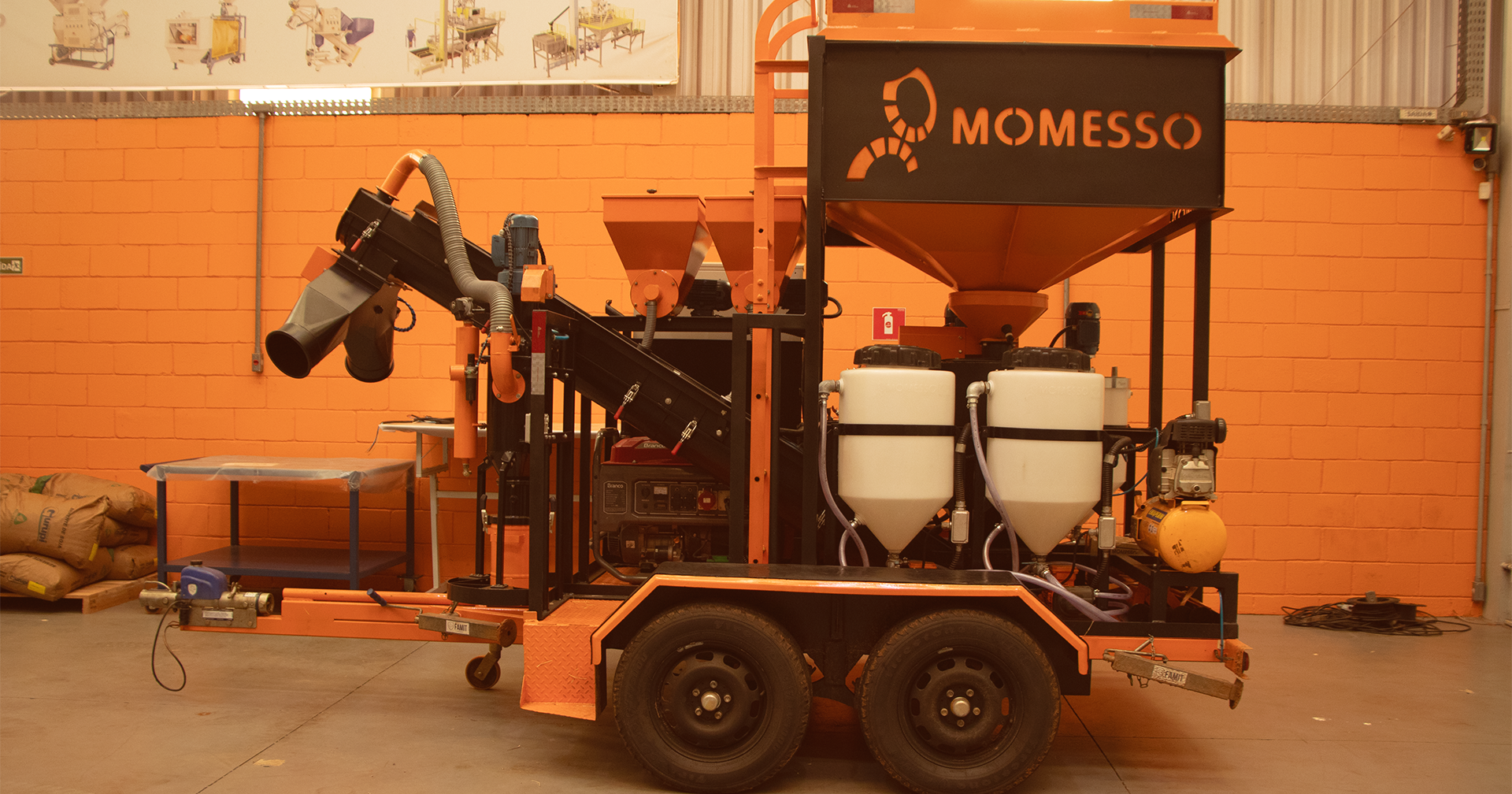
The pillars of a well-executed seed treatment: precision, uniformity, and control
Understand how precision, uniformity and control form the basis of a stable, repeatable and technically well-conducted seed treatment.
Seed treatment goes beyond product application
Seed treatment is one of the most sensitive stages in the production chain. Although it is often associated only with the application of pesticides, it involves a series of technical decisions that directly impact the stability of the process and the behavior of the seed in the field.
For Momesso, To treat seeds is to conduct a process. A process that needs to be understood, adjusted and monitored over time. Within this vision, three pillars underpin a well-conducted treatment: precision, uniformity and control.
When these pillars work together, the operation gains consistency and predictability. When one of them fails, variations start to appear throughout the flow.
Accuracy: apply the correct dose with operational consistency
A precision is the starting point for seed treatment. It is related to the ability to apply the volume of fertilizer according to the technical recommendation, respecting the relationship between the product and the quantity of seeds treated.
Dose variations, even small ones, tend to accumulate over the course of the batch. Underdosing reduces the effectiveness of the treatment, while overdosing can compromise seed vigor and generate operational waste.
In solutions Momesso, Precision is achieved through dosing systems that follow the actual flow of seeds, allowing the application to remain stable throughout the operation. Precision therefore requires a correct reading of the process and well-defined adjustments.
Uniformity: when the application becomes a coating
A uniformity is the pillar that connects the dose applied to the final result of the treatment. It is not enough to apply the correct volume of product if it is not evenly distributed among all the seeds in the batch.
Proper homogenization reduces points of excess and gaps in coverage, favoring a more consistent coverage. This balance directly influences seed flow, both inside the machine and when sowing.
When uniformity is compromised, seeds with different levels of protection appear, which generates variability in the batch's behavior. For this reason, the balanced distribution of the mixture is a decisive factor in the consistency of the treatment.
In Momesso engineering, uniformity is treated as the result of the interaction between atomization, mixing and internal flow, always considering the actual behavior of the seeds.
Process control: the basis of repeatability
O process control is the pillar that supports the repeatability of the treatment. It involves continuous monitoring of parameters such as mixture flow rate, seed flow, residence time and mixture behavior throughout the operation.
When we monitor this data and interpret it correctly, the process becomes more predictable and less dependent on corrective interventions. Control allows punctual adjustments and reduces deviations between batches.
For Momesso, repeatability is not the result of chance. It comes from well-defined processes, clear parameters and consistent technical monitoring. Control turns treatment into a reliable technical routine, regardless of the operator or the time of harvest.
The integration of precision, uniformity and control
Although each pillar has its own specific function, it is the integration between them that defines the quality of treatment. Precision without uniformity generates correct application but uneven coverage. Uniformity without control loses stability over time. Control without precision compromises the basis of the process.
When the three of them work together, treatment evolves from a reactive operation to a structured process. The machine is no longer just a piece of equipment, but a technical tool that enables more informed decisions.
This integration is one of the principles guiding the development of Momesso solutions, always with a focus on reducing variables and strengthening operational consistency.
Well-conducted treatment is the result of method and understanding
In practice, a well-conducted seed treatment is one in which the operator understands the reason for each adjustment, recognizes the batch's behavior and acts preventively, not just correctively.
This understanding transforms the CTS. The process becomes more fluid, the adjustments more solid and the results more consistent over time.
For Momesso, handling seeds well means applying technique, method and knowledge in an integrated way, respecting the particularities of each operation and strengthening the predictability of the process.
Consistency built batch after batch
Precision, uniformity and control are not isolated concepts. They form the technical basis of a treatment that seeks consistency and coherence throughout the harvest.
By structuring the process on these pillars, CTS creates the conditions to evolve its operation, reduce interference and strengthen the stability of seed treatment.
It is from this continuous construction, batch after batch, that more solid processes and more reliable results in the field are born.
Want to deepen your understanding of the factors that influence the quality of seed treatment? Explore other Momesso's technical content.
READ ALSO:

Are you afraid of becoming a more technological producer?
