The Invisible Quality of Treated Seed that Impacts Your Profitability
A seed may seem well-treated, but invisible flaws in the process are costly. Discover the technical details you don't see but that determine the success or failure of your stand.
In agribusiness, what you see rarely tells the whole story. A seed with vibrant, uniform coloration gives the impression of a job well done at first glance. It suggests protection, care, and security. The problem is that this visual perception, when isolated, can hide relevant risks for the crop and for the profitability of the harvest.
The color is just the finish. The true quality of an industrial seed treatment lies in factors that aren't apparent at a quick glance, nor at the bottom of the bag, nor even at the moment of purchase. These are silent, technical variables that only reveal themselves throughout the crop cycle and, inevitably, in the financial outcome.
Ignoring these variables means trading engineering for appearance. It's trusting what seems right instead of understanding how the process was conducted. And the cost of this choice almost always appears too late, when there's no longer room for correction.
Invisible quality #1: the right dose in every seed
When purchasing treated seed, the producer pays for the promise that it contains the recommended dose of pesticides and other active ingredients. This dose was defined by research, testing, and agronomic validation. What is not seen, however, is whether this dose was applied with precision and, especially, uniformly.
In processes without automated control, the variation is much greater than one might imagine. The lot average may even be within the expected value, but, seed by seed, the scenario is different. Some receive excess product, while many receive less than necessary.
This failure goes unnoticed because all the seeds come out colored. The polymer that gives the uniform visual appearance masks the uneven distribution of active ingredients, precisely the most expensive and most important part of the seed coating. The vulnerable seed looks the same as the well-protected seed.
The impact appears in the field. The stand is born irregular, with dominated plants, more susceptible to pests and diseases that should have been controlled at the source. Each failure represents an unproductive space, a genetic potential that was not expressed. At the end of the harvest, this translates into fewer bags per hectare, caused by a lack of precision that was never visible at the time of purchase.
Invisible Quality #2: Adhesion and the Silent Cost of Dust
Another frequently overlooked sign is the dust that accumulates at the bottom of seed packets. In some cases, it's even interpreted as normal or as an “excess product.” In practice, it's the exact opposite.
This powder is the result of poor adhesion of the treatment to the seed. It indicates that the film did not anchor correctly, either due to inadequate drying, haste in the process, use of inappropriate polymers, or chemical incompatibility of the slurry. It is a high-value product that has detached from the seed.
At the time of treatment, nothing seems wrong. The seed comes out moist and looks good. The problem manifests later, during transport, storage, and handling. That's why this failure goes unnoticed at the source.
The financial impact is multifaceted. First, there is the direct loss: pesticides, nutrients, and additives that were paid for do not reach the soil. Second, this dust interferes with planting, clogging seeding disc openers and sensors, causing skips, doubles, and constant stops for cleaning. Third, there is occupational and environmental risk, with operators and the environment exposed to concentrated chemical particles, something that a well-executed seed treatment prevents.
Invisible Quality #3: Mechanical Damage That Reduces Stamina
Even when seeds show good germination rates in the lab, they can carry an invisible problem: mechanical damage caused by an aggressive treatment process.
Seed treatment isn't just chemical. It involves transport, mixing, and movement. Poorly designed systems, with high speeds, excessive friction points, or inadequate geometries, can cause microcracks in the seed coat.
These damages are not detectable by the naked eye and often do not appear in standard germination tests conducted under ideal conditions. However, in the field, the reality is different. These microcracks become entry points for pathogens and points of physiological stress.
The result is a seed with reduced vigor. It may still emerge, but more slowly and weakly, losing its ability to compete, explore the soil, and resist initial stresses. A low-vigor stand starts at a disadvantage, and this difference follows the crop until harvest, reducing its productive potential.
Demand engineering, not just looks
The producer seeking maximum profitability can no longer evaluate treated seed solely by its color. It is necessary to question the process behind its appearance.
Understanding how dosage is controlled, how application is distributed, how adherence is ensured, and how equipment is designed to preserve seed integrity makes all the difference. It is these technical choices that determine whether the treatment fulfills its role or just appears correct.
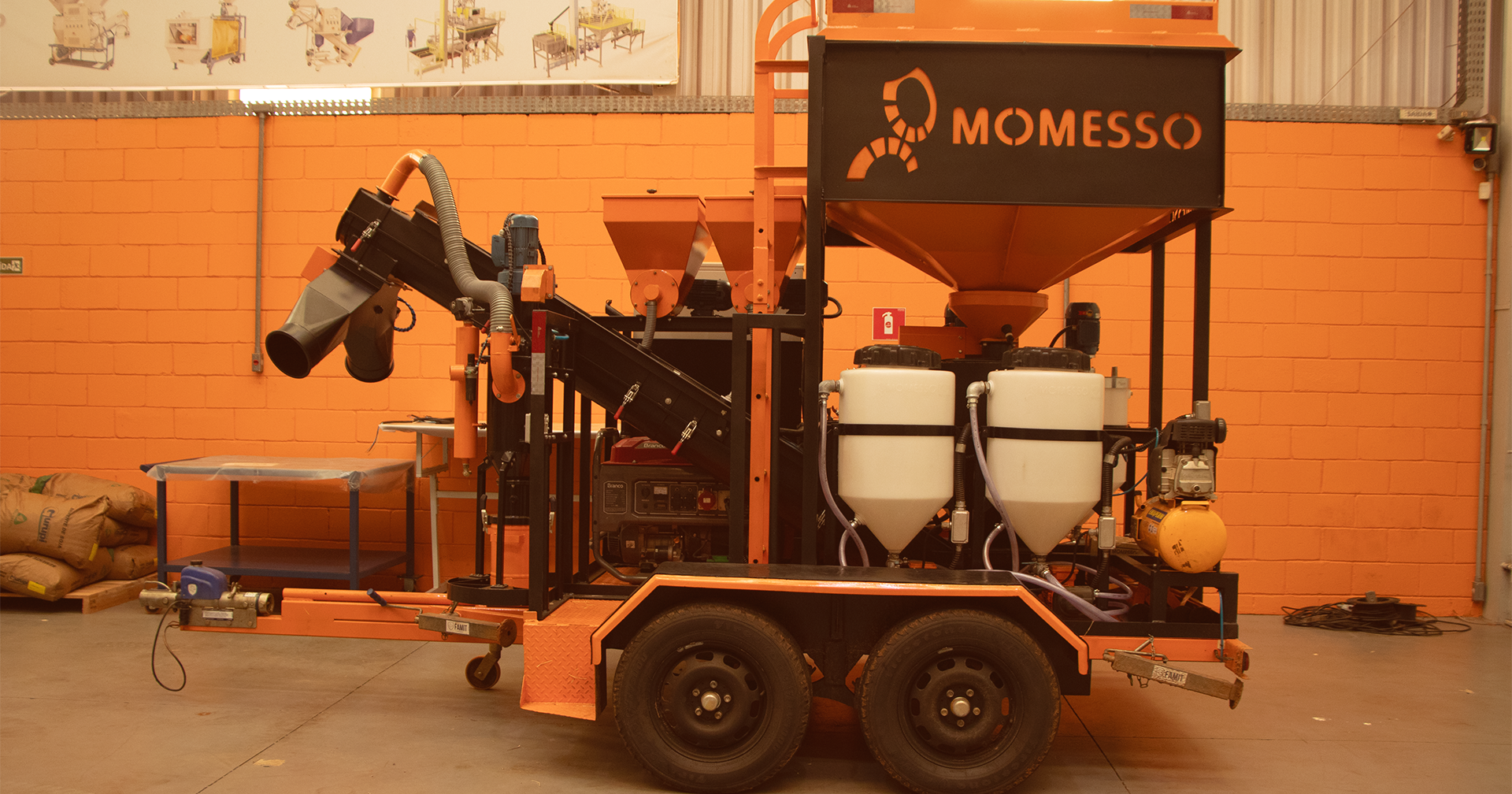
Momesso develops equipment for those who understand this difference. The technology is directed towards controlling the invisible variables, because they are what sustain the visible result in the field.
When choosing a seed partner or a treatment service provider, aesthetics should not be the sole criterion. What's at stake is not the appearance of the seed, but the financial health of the crop. And in agribusiness, what you don't see today is usually what weighs most heavily on the results tomorrow.
READ ALSO:
Seed machine sizing: efficiency comes from the right equipment for your flow