
Seed machine sizing: efficiency comes from the right equipment for your flow
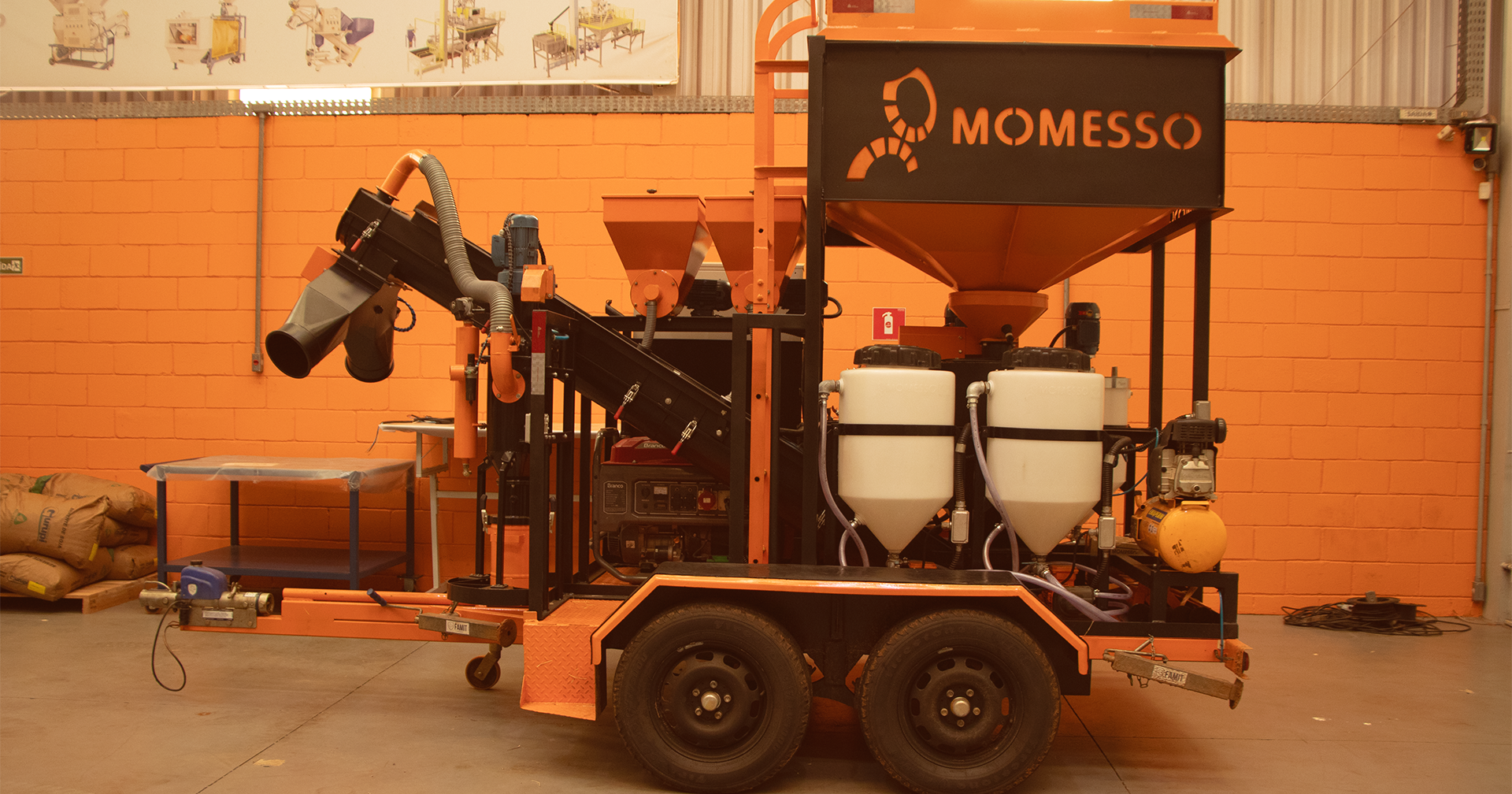
Understand how to size seed machines to operate in the optimal range, reduce cost per ton, and maintain repeatability in treatment, without idle capacity or bottlenecks during the harvest season.
A properly sized machine is like a well-organized batch of seeds: flow happens with less friction, quality remains stable, and resources are used intelligently. Yet, when investing in new equipment, the decision often focuses almost exclusively on maximum nominal capacity. This mental shortcut, though seemingly safe, often generates the opposite effect: recurring inefficiencies, process instability, and a silent increase in the cost per ton processed.
The true efficiency of industrial equipment lies not in its size, but in its suitability for the actual flow of operation. Correct sizing is a technical and strategic decision that directly impacts treatment quality, daily predictability, and business profitability. More than choosing “how much the machine can handle,” it's about understanding she will work most of the time.
Optimal operating range and cost per ton: the central concept
All industrial equipment is designed to deliver its best performance within a specific operating range. In the case of seed treatment machines, it is within this range that all systems function in balance: atomization occurs efficiently, homogenization is consistent, and controls act with greater precision.
When the operation works outside this range, whether too far below or too far above, the impact is not limited to productivity. It directly affects the cost per ton. And this cost goes far beyond the initial investment in equipment. It involves energy consumption, labor, setup time, material losses, and, most importantly, the cost associated with loss of quality and treatment repeatability.
In other words, a machine may seem adequate on paper, but operate inefficiently in practice if it's not aligned with the actual plant flow.
Oversizing: When Idle Capacity Generates Inefficiency
The decision to acquire a larger machine envisioning future expansion is common and, at first glance, prudent. The problem arises when this equipment routinely operates far below its ideal capacity. In this scenario, idle capacity ceases to be a safeguard and becomes a source of inefficiency.
Quality and standard of care
In a large treatment chamber, a very low flow rate of seeds compromises the uniformity of the process. Homogenization systems designed for larger volumes fail to promote optimal contact between seeds, and dosage accuracy can be affected as pumps and meters begin to operate outside their ideal flow rate range. The result is a loss of stability in the most important pillars of treatment: accuracy and uniformity.
Disproportionate energy consumption
Larger motors and drive systems have a significant fixed consumption to keep the assembly running. When the delivery of tons per hour is low, a larger portion of the energy is spent just to “keep the machine running,” increasing the energy cost per ton processed.
Setup and cleanup with excessive weight
The time and volume of inputs required for cleaning and recipe changeover are largely independent of batch size. In large machines operating with small loads, this fixed cost becomes a much larger part of the process, reducing the economic efficiency of operations with many batches or greater fractionation.
Undersizing: the bottleneck that squeezes quality
If oversizing generates silent inefficiency, undersizing often manifests itself more directly. It creates bottlenecks, queues, and constant pressure, especially during peak harvest times, affecting not only the pace of the operation but also the quality standards.
Pressure to speed up the process
When there is pent-up demand, the tendency is to push the machine beyond its optimal capacity. This reduces the seed's residence time in the treatment chamber, compromising homogenization, application, and drying. The operation delivers volume, but compromises quality.
Extended shifts and operating cost
The machine becomes the limiting factor of the plant, requiring longer shifts and greater effort from the team. In addition to the increased labor costs, the risk of operational errors associated with fatigue and operating under pressure grows.
Loss of repeatability
The need to “fit” the volume leads to non-standard adjustments and reactive decisions. With this, the process loses its ability to be repeated consistently, batch after batch, undermining the predictability that industrial treatment demands.
Sizing properly means analyzing the flow, not just the machine.
Mature sizing doesn't just start with the equipment's nominal capacity. It begins with an analysis of the plant's complete flow and the actual operating characteristics.
The first point is to understand peak demand within the critical harvest window, not the annual average. It's this peak that needs to be reliably met. Next, it's essential to consider the average batch size and the frequency of recipe changes, as frequent setups completely alter the logic of efficiency.
Finally, the treatment machine must be integrated with the rest of the line. Its capacity must be compatible with the upstream equipment supplying it and the downstream equipment receiving the treated product. The goal is not to maximize an isolated point, but to balance the system as a whole to maintain a continuous and stable flow.
The right capacity is one that works within the ideal range
The best machine isn't the biggest. It's the one that operates most of the time within its optimal range, with a setup process that aligns with real-world batch sizes and is perfectly integrated into the plant's workflow. This harmony is what sustains repeatability, predictability, and cost control throughout the season.
Proper sizing is therefore one of the most important strategic decisions for those seeking not only to treat seeds but to build an efficient industrial operation, with control over their processes and the quality of the product delivered to the market.
This is precisely the vision that guides the development of the solutions from Momessomachines designed to work where efficiency truly happens, in the right range, with control, stability, and a focus on results.
READ ALSO:

Is a brightly colored seed well-treated?