Fungi in corn: where they come from and how precise seed treatment protects your crop's start
Understand the three main origins of fungi in corn, their impacts on crop establishment, and why precision in seed treatment With Momesso technology, protection is elevated from the very first grain.
Why talk about fungi before sowing?
Anyone who produces corn knows that the game starts long before emergence. Even with the correct planting window and adequate moisture, failures, weak seedlings, and rots can appear. In most cases, the origin lies in three silent fronts that carry the inoculum to the field: the seed itself, the soil, and crop residues. Anticipating this risk can change the outcome of the harvest.
But what are the three most frequent sources of contamination?
In the seed itself
Some pathogens can come with the batch, such as Fusarium and Acremonium, causing seedling weakening, increased susceptibility to stem and ear rot, and dissemination of inoculum to new areas without the producer realizing it.
Not only
The furrow environment is challenging, especially under variations in temperature and humidity. Thus, soilborne pathogens such as Pythium, Rhizoctonia, Fusarium, and Stenocarpella are associated with:
- Seedling damping off in the early days
- Root and hypocotyl rot
- Emergency failures and irregular stand
3) In our cultural remains
Residues from the previous crop can harbor pathogens and serve as a green bridge for the subsequent harvest. Corn anthracnose (Colletotrichum) is an example that finds shelter in crop residues. During periods of higher humidity, the disease reappears, affecting stalks, leaves, and ears.
And what's the agronomic impact that hits the wallet?
- Fewer plants per hectare, with reduced productivity.
- Mismatched plants compete unevenly and reduce the efficiency of light, water, and nutrients.
- Greater pressure from diseases in the reproductive stage, with stem rot and compromised ear.
- Risk of quality losses: some pathogens are associated with grain spoilage during harvest and post-harvest.
Therefore, the answer begins before planting, with seed treatment.
Seed treatment isn't just applying a product. It's a risk management strategy that acts at the most critical point of the cycle: the beginning. When well executed, it reduces the initial pressure of pathogens coming from the seed, soil, and residues, ensuring a more vigorous and uniform start.
Why do accuracy and consistency matter?
- The right dose in the right grain, as underdosing compromises protection, overdosing increases costs and can affect physiological quality.
- With homogeneous coverage, the regular distribution of the active ingredient and polymer helps reduce protection failures between seeds from the same lot.
- Adhesion and slurry stability improve treatment curing and reduce dust, preserving the treatment until seeding.
- Traceability and repeatability in stable processes allow for repeating results across different batches and windows.
And that's where Momesso comes in to make a difference. But how?
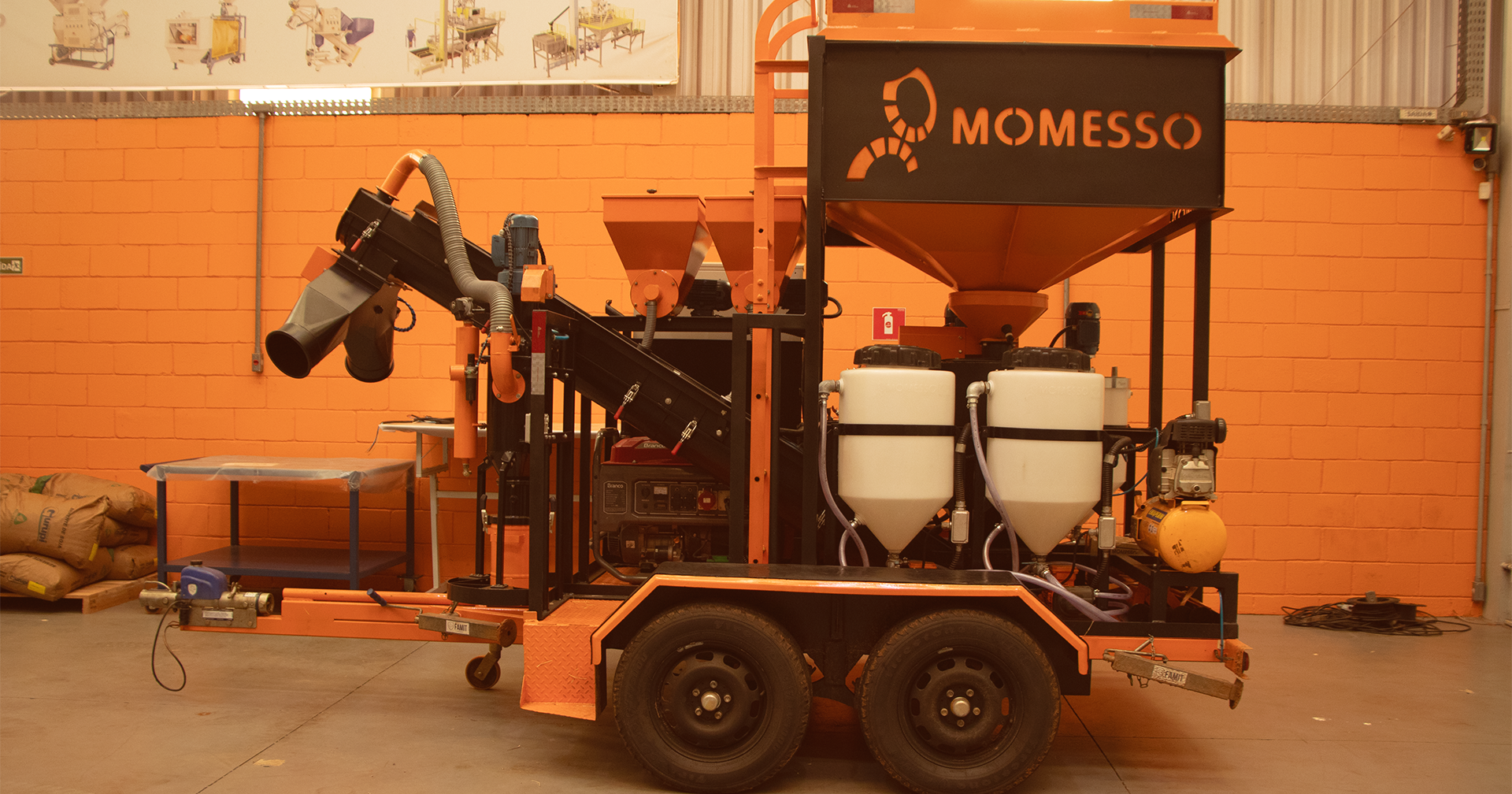
With technology designed for precision and uniformity from the first seed, Momesso helps you turn seed treatment into an advantage.
Key points of Momesso technology applied to the daily lives of producers and seed growers:
- Consistent dosing and mixing to maintain active ingredient concentration within the target range throughout the batch.
- Application and coating system that promotes homogeneous distribution, better finish, and less variability between seeds.
- Integration with polymers, post-drying, and curing for treatment stability and improved seed flowability.
- Automation and process control that reduce human interference, ensure repeatability, and allow for lot traceability.
- Technical support and best practices based on field experience for calibrating, validating, and maintaining the application standard.
What would be the expected outcome? A plantation with more security and more predictable harvests. But of course, it is still necessary for other factors to be aligned as well, thus, seed treatment is a central pillar, but yields more when it is part of a set of good practices:
- Crop rotation that breaks the cycle of pathogens associated with corn.
- Management of crop residues to reduce inoculum survival between harvests.
- Sowing in favorable soil conditions regarding temperature and moisture, avoiding initial stress.
- Correct seeding depth and pressure with a well-adjusted machine, ensuring seed-to-soil contact and uniform emergence.
- Seed physiological quality suitable for the productivity goal.
- Technical support to adjust hybrid positioning, window, and dosage of technologies in treatment.
To help you, here are 3 practical checklists to assist you:
Pre-treatment
- Validate seed lot quality and moisture content
- Check compatibility between assets, polymers, and micronutrients
- Define target dose and spray volume per acre.
- Calibrate the application line and the coating system
- Prepare records for traceability by batch
During treatment
- Monitor viscosity of the slurry and application rate
- Evaluate visual coverage and thousand-seed weight as process controls
- Check temperature and curing time before packaging
- Register treated batch parameters for repeatability
Post-treatment and planting
- Store in stable conditions, protecting from heat
- Test flow and dust before sending to the field
- Validate planter adjustment with the treated batch
- Monitor emergency and stand in sample plots
Now that you are aligned with these best practices, it's time to put the knowledge into action. Fungi that come from seeds, soil, and crop residue act silently right at the beginning of the harvest, when the plant is most vulnerable.
The producer who anticipates this risk and combines precise, uniform seed treatment with disciplined management creates a safer start, reduces losses, and increases crop predictability.
Treated well. Treated Momesso.
READ ALSO:
Seed machine sizing: efficiency comes from the right equipment for your flow